May 14, 2026
3 minutes
Rachel Azagury
May 14, 2026
3 minutes
Last updated: May 12, 2026
Email marketing for a DTC beauty brand in 2026 costs between $2,500 and $15,000 per month all-in, depending on revenue stage, list size, and whether the work is handled by an agency, freelancer, or in-house team. The total has three components: a Klaviyo subscription ($20 to $1,300+/month based on list size), labor ($1,500 to $12,000+/month), and design or strategy costs (often bundled into labor, $500 to $2,500/month if separated).
For most growing DTC beauty brands at the $2–10M revenue stage — where the channel becomes mission-critical rather than nice-to-have — expect to spend $4,500 to $9,500 per month to run email properly. At that investment level, email should be generating 25% to 40% of total store revenue.
The rest of this guide breaks down each cost component, what you should expect at each revenue stage, the hidden costs most founders miss, and how to decide between DIY, freelance, agency, and in-house.
Email marketing isn't one line item. It's three, sometimes four:
Most founders look at the agency retainer and stop there. The platform cost alone can quietly grow into a five-figure annual bill as your list scales.
Klaviyo is the default for DTC beauty brands for a reason — its segmentation, predictive analytics, and Shopify integration are unmatched in the under-$10M segment. But its pricing model changed in 2025, and a lot of founders are now paying more than they realize.
Klaviyo bills based on active profiles in your database, not emails sent. As of February 2025, every subscribed contact in your account counts toward your tier — whether you email them or not. A business with 100,000 total profiles but only emailing 30,000 actively engaged contacts now pays for all 100,000 profiles. List hygiene is now a cost-control issue, not just a deliverability one.
Verified 2026 Klaviyo pricing by list size:
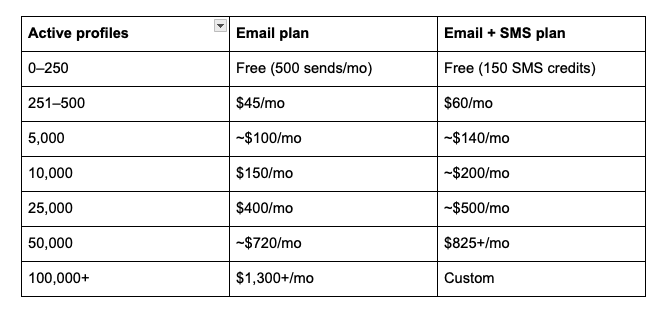
Sources: Klaviyo's pricing page; third-party 2026 pricing analysis at CheckThat.ai; 2026 Klaviyo pricing breakdown at klaviyopricing.com.
A few things to know:
If you're sitting on a list with 30%+ unengaged subscribers, suppressing them can drop your Klaviyo bill by hundreds of dollars per month without affecting revenue. Cleaning your list quarterly is now a budget exercise.
This is the line item with the most variance — and the most confusion.
$1,500–$3,500/month
A solo Klaviyo specialist working part-time on your account. Best for brands under $1M doing 2–4 campaigns per month with basic flow setup. The risk: most freelancers can execute but not strategize. You'll get sends, not a growth engine. Turnover and bandwidth are also issues — when your freelancer takes on a new client, you usually feel it.
$3,500–$8,000/month
A small specialist team handling strategy, copy, design, build, send, and reporting. This is the right fit for most brands at $2–10M because you get senior-level strategic input, design quality, and a team that won't disappear when one person quits. At this tier you should expect: 6–10 campaigns per month, fully built core flow stack (welcome, abandoned cart, browse abandonment, post-purchase, win-back, replenishment for skincare/supplements), monthly reporting calls, and ongoing list growth and segmentation work.
$7,500–$15,000/month
Bigger team, more layers, often broader scope (email + SMS + occasionally paid social or retention strategy). Best for brands at $10M+ or brands where email is a major channel doing $200K+/month in attributed revenue. You're paying for capacity and process maturity, not necessarily better creative.
$15,000–$35,000+/month
Multi-channel, multi-brand teams. Usually overkill for a single beauty brand under $20M. Most brands in this band would be better served by a strong boutique partner plus a part-time in-house lead.
$70,000–$95,000/year fully loaded for a mid-level email marketing manager (salary, benefits, taxes, tools). Add $5,000–$15,000/year for tools beyond Klaviyo (design subscriptions, project management, analytics).
In-house starts making sense when you're consistently spending $10K+/month on agency labor and you have enough other marketing work to keep someone fully utilized. Most beauty brands hit that threshold around $8–12M in revenue.
These are realistic ranges for a DTC beauty brand running email properly — not bare-minimum survival mode.
Under $1M revenue:
At this stage, the founder usually handles email themselves with templates and AI assistance. The first hire is rarely email-specific — it's usually a generalist. If you outsource, do it surgically: pay a specialist $2,000–$3,000 to build your core flows correctly once, then you maintain them.
$1M–$3M revenue:
This is the danger zone. Email becomes a meaningful revenue channel but most founders are still trying to run it themselves on top of everything else. The cost of not investing here is bigger than the cost of investing.
$3M–$10M revenue:
Email should be generating 25–40% of total revenue at this stage. If you're spending $8,000/month on email and the channel is doing $250,000/month in attributed revenue, your math works. If it's doing $50,000/month, the problem isn't the budget — it's the strategy.
$10M+ revenue:
At this scale most brands move to a hybrid model: an in-house email lead managing day-to-day plus an agency partner for strategy, design, and overflow capacity.
The sticker price of your agency retainer is rarely the full picture. The four costs that surprise people:
A healthy DTC beauty brand running email properly should see:
If you're paying $7,000/month for email and the channel is doing less than 20% of total revenue after 6 months of work, something is broken — usually strategy, segmentation, or send frequency. The investment level isn't the issue.
A simple decision framework:
The mistake we see most often: brands at $3–5M hiring a $1,500/month freelancer to save money. The opportunity cost — flows that don't convert, campaigns that don't ship, segments that don't exist — is usually 10x the savings.
How much should a $3M skincare brand budget for email marketing?
Plan for $5,500–$8,500/month all-in, including Klaviyo ($300–$500/month), agency or specialist labor ($5,000–$7,500/month), and ancillary tools (~$200–$500/month). At that investment, email should be generating $750K–$1.2M in attributed annual revenue.
Is Klaviyo worth it for a small beauty brand?
Yes, in almost every case. Klaviyo's free tier covers brands up to 250 subscribers, and the segmentation, predictive analytics, and Shopify integration outperform Mailchimp and most alternatives once you cross 1,000 subscribers. The platform is built for ecommerce in a way Mailchimp isn't.
How much does it cost to set up Klaviyo flows from scratch?
A one-time setup of the core flow stack (welcome, abandoned cart, browse abandonment, post-purchase, win-back) typically costs $2,500–$8,000 depending on complexity, brand customization, and whether SMS is included. Certified partner agencies typically charge under $2,500 for basic implementations and over $10,000 for complex migrations.
Do I need SMS in addition to email?
For DTC beauty, yes — eventually. SMS typically adds 10–20% incremental revenue on top of email when integrated into flows (not used standalone). Start with email, then layer SMS once your list crosses ~5,000 subscribers and you have abandoned cart and post-purchase flows running.
Should I migrate from Mailchimp to Klaviyo?
If you're a DTC ecommerce brand on Shopify doing more than $500K in annual revenue, yes. Mailchimp's pricing is cheaper at lower tiers, but its ecommerce features are limited and you'll outgrow it quickly. Migration costs typically run $2,000–$5,000 with an agency and take 2–4 weeks.
How long until email marketing starts working?
Core flows (welcome, abandoned cart) start generating revenue within the first 30 days of being live. Full channel maturity — where email reliably hits 25%+ of revenue — typically takes 4–6 months of consistent work.
This article was written by The Concept Agency, a boutique DTC growth marketing agency specializing in beauty, wellness, skincare, fragrance, and jewelry brands at the $2M to $10M revenue stage. We've managed Klaviyo accounts for 20+ brands and generated millions in attributed email revenue. To talk through what email should look like at your stage, book a call.
.png)